Friday, June 28, 2024

Part 2: Singapore-Malay Bawean - self-actualisation.

PART 2/3

My older brothers, Ariff and Ismail, with uncles Cik Yusof and Cik At-at, who are of the same age as my elder brothers respectively. At Joon Tong Road, off Old Jurong Road; circa 1970s.


My family spent many weekends at either the paternal or maternal grandparent’s place. However the weekend before the beginning of school after a long semester break would be particularly special. For example, my father’s siblings would gather with their kids at his parent’s place at Teban. After Maghrib, we would have kenduri, or prayer feast, to celebrate the achievements of the previous year and welcome the new one. The eldest family member, my grand uncle, would recite verses from the Quran over a cup of water. This “blessed” cup would be passed around to the kids to sip for good grades and overall best performance in school, and to shield us from accidents and bad luck. 

Nonetheless with a reminder the ultimate blessing comes from Allah. We seek His grace.

On other days, such blessed water would be prepared for a family member starting a new job, going for an interview, enlisting in National Service, after a job promotion, getting married, traveling overseas, or moving to a new house. Occasionally, there was blessed water for the sick or for those recovering from severe or chronic illness.

My family was also present for my uncles’ and aunties’ khatam Quran milestones. My older siblings had their khatams too. During childhood, it was common for the head of the household, usually the father, to teach the children basic Iqra, often in the “Bawean style.” My father’s flawless recitation of Quran was captivating. During Ramadan, my grandparent’s living room hosted congregational Tarawih prayers after breaking fast without fail, although my cousins and I would be excused. We watched from the sidelines, often bored by the second rakaath, or prayer cycle, and played our own games in the background.

For early Baweans being a perantau or traveller meant that every chance to connect with a fellow Bawean overseas was a chance to rekindle relationships. Thus everyone was family. At the turn of the century, the Ponthuk that dotted many parts of urban Singapore was the point of call for most single travellers who left Bawean. Each Pondok was linked to a respective province at home. Upon arrival a Pak Lurah, the head of the Pondok, welcomed the traveller. He subsequently took care of the new arrival’s welfare until he settled down with a job or ready to move out. This tradition of kinship and hospitality maintained even when the Pondok ceased to exist. Maintaining family foundations and practising kindness were also part of being good Sunni Muslims.

My grandparents did not live in a Pondok. They lived in Jurong. They were workers and labourers in various plantations of wealthy Baba Peranakans in Jurong. There were also Javanese workers, workers from India and sprinkle of Chinese workers.

On very rare occasions when I tagged along my father to visit my elderly grand relatives, the conversations trailed to unwell acquaintances or victims of suspected hexes. The language was coded and matter-of-fact, making it sound like something that happened in Bawean Island to my untrained child ears. Upon reflection, I noticed my father never brought my older brothers to such meetings, perhaps because the unspoken rule was to be respectful and not ask too many questions. Perhaps my father liked to take me because I was well behaved and not being disruptive when the elders spoke. Or perhaps it could also be I did not have any homework to complete.

I would hear about entities, spells, special compounds, significant energies, and anecdotes warning children like me not to trivialize Taoist roadside offerings during the Hungry Ghost Festival or to maintain integrity in daily dealings because karma is real. 

This early exposure to such conversations ingrained in me a scientific approach to the entities of the sixth sense in Bawean lore. Having insider knowledge allows one to form effective perspectives and drive positive change naturally embedded in the culture.

My father emphasised secular education for his children as a means to move up beyond the blue-collar system that most of the Baweans came from. Thus, even when I was attending Anglo-Chinese School, a Methodist mission school, I was concurrently attending Madrasah classes in the morning or afternoon, depending on my secular school sessions. I listened to the ustazah talking on fitrah in the morning and then listened as the pastor led the hymns in the afternoon. 

It was also in ACS when I watched my wealthy classmates being herded from/into chauffeur-driven cars before/after school. It was like a scene straight out of P Ramlee films. It was later that I found out later many of these chauffeurs were Bawean men. I made many films from these experience - Sama-sama (MINDEF, 2018), Ada Jalan (SG Story, 2025).

As I moved on to junior college, I met more Malay friends of other ethnicities besides Baweanese, such as the Javanese and Bugis. When you mingle with people within your own community, you became aware of the subtle differences within the larger Malay community. It was also here that I discovered the stereotypes and derogatory name-calling that framed the discrimination the early Baweans faced within the Malay community. 

The most common was how the Baweans were deemed to be unchaste due to stereotypes of the community’s attribution to black magic and the community’s love of the bloody tongkol - Bawean for the tuna. Blood and magic seem like a sexy concoction. Thus it was impossible for a Bawean boy or girl to marry a Javanese, for example, because of the prejudice that sprang from these stereotypes. 

The stigma ran deep. So deep that many Bawean families learned to survive by distancing themselves from their own roots, quietly blending in. The name “Bawean” faded into the background.

These derogatory name-calling is, unfortunately still rampant among the bumiputra Malays in Malaysia towards the local-born Baweans there.

I was intrigued to learn how many local Baweans felt embarrassed to be identified as Bawean. Some went to great lengths instead to identify as Javanese or Arab (many Baweans are fair-skinned and have sharper features). I started to make sense of this curious phenomenon years later, while researching a documentary on Singapore’s turbulent mid-60s for a State ministry museum exhibit. I read about the tragic bombing of MacDonald House along Orchard Road during Konfrontasi, which left three dead and thirty-three injured. The attack, carried out by two Indonesian marines, Harun bin Said and Osman bin Haji Muhammad Ali, deeply strained relations between Singapore and Indonesia. When I discovered that Harun bin Said was of Bawean descent, it struck me that perhaps the distancing among local Baweans then was a quiet act of self-preservation - a way to shield themselves from association with the tragedy, at a time when identity itself could be a liability.

In 1997, I was working on a television documentary about the Bawean diaspora in Singapore. During the filming trip to Bawean Island, we stayed in a Pesantren. Guarded by the spoken and unspoken rules of the Baweanese, I confronted my heritage full-on. There were many questions, and being on the island where my grandparents came from was the best way to confront them.

Observing the culturally conservative and very religious Bawean islanders, I asked the head of the Pesantren, a soft-spoken Haji, if it was true that Baweans practiced black magic, given the community’s notorious reputation in Singapore. Silence. It was as if the Haji was trying to figure out the context of my question. His body language at that point reminded me of the elders who spoke to my father when someone asked an awkward question.

He calmly explained that one cannot blame the people, the family, the community, beliefs or religion for the deed of the individual. God is almighty, He provides guidance, and fate brings us where we are. At that point I could not seem to comprehend his loaded and complex response. Out of respect to the host, I left it as that.

Back in Singapore, while filming this documentary, I met an elderly Bawean with a road named after him at Caldecott Hill. He was rumoured to be a spiritual advisor to a very prominent figure in Singapore. A first-generation migrant, slight in size and non-assuming, he had a special gaze typical of learned elderly Baweans. It was the same gaze of the elders that spoke to my father when I was little. It is complex to describe the gaze but one that I can identify when I see it. I asked him the same question about black magic. 

He simply smiled. He did not respond.

I remember when I was little, when an elderly Bawean responded with no response, that was a code to mean you are being “kurang ajar”. In Phebien, being confrontational was seen as rudeness of the highest degree. In Bawean speak, kurang ajar means your parents, grandparents and guardians failed to teach you well in graces and manners. It was like having your whole family clan and generations before you, spat at. At the end of the interview, I took the man’s hand and kissed it as a sign of quiet apology.

Being exposed to the mechanics of the sixth sense and its entities as a child, and confronting these experiences professionally while making the documentary about Bawean diaspora in Singapore, led me to embrace my history. Dwelling on something unfairly attributed to my heritage and attempting to find reason in its mechanisms meant I had to make peace with it. There are good people and some, on the contrary, just as there is good and bad in everyone, every culture, every community. Eventually, what brings closure is acknowledging and making peace with it.
"..Yeah, you better be careful, or I will send the spirits down your way to kick your a**!"
I used to joke in response to every unfair snide remark about Baweans and the sixth sense. 

Little did I know.

[Read PART 1, read PART 3]

Monday, June 24, 2024

Part 1: Singapore-Malay Bawean - growing up within.

PART 1/3

My elder brother, Ismail, and I. At Joon Tong Road, off Old Jurong Road; circa 1970s.

I never thought the shadows of old beliefs would find their way back into my life.

They say the old ways have faded, but maybe not completely. I never expected that a long-standing, unfair belief tied to the Phebien, my Bawean heritage, one the elders often dismissed and I quietly underestimated, would return in such a personal way. I’ve always believed there are things beyond logic, but they never touched me or coloured my days.

I was more of a Scully than a Mulder from The X-Files, grounded, skeptical, and rational. But something changed in late 2016. Something unseen, heavy and strange began to take shape in ways I couldn’t reason through. My health declined and I ended up in the hospital for nearly a month. Recovery took time. It still does.

Even now, when I think back, I’m not sure whether to call it coincidence, fate, or a quiet reminder that the old world and ours still meet, just not always on our terms.

This is a 3-part blog on my journey navigating the dark experience.

Let me begin. I was born and raised in a traditional Singapore-Malay Baweanese household. My maternal and paternal grandparents left Bawean Island (off the coast of Surabaya, Indonesia) after World War II. They arrived in colonial Singapore and eventually took residence here. That makes me a third-generation Singaporean. I served my National Service in one of the three elite units of the Singapore Armed Forces as a pioneer Singaporean-Malay Commando enlistee. I hold the Singapore pink identity card, sealing my allegiance to Singapore. I even made a short film, The Usual, commissioned by MINDEF, based on my years growing up at Jalan Majapahit, off Old Jurong Road. The following year, the ministry commissioned another film, Sama Sama, my take on the bonds that make us Singaporeans.

I think I had a remarkably interesting childhood. Many would agree and even see it as challenging and uniquely formative.

I spent much of my early years with my maternal grandmother in a quaint Baweanese community at Joon Tong Road, off Old Jurong Road, in the early 70s. My parents dropped me off in the morning before work and picked me up in the evening when they returned. On weekends and occasionally during the weekdays, when my parents were too tired, I would sleep over at my grandparent’s. These stays were most enjoyable because I immersed myself in a distinct cultural space. My grandparents and the neighbours still held much of the traditional customs and ways they brought from Bawean.

Two aspects of Baweanese culture have fascinated me, even today - the spoken language and its cultural beliefs and practices.

I inevitably picked up the Baweanese language at a very young age. At my grandparent’s house, conversations were predominantly in Baweanese. Even my secular school-going aunties and uncles spoke Bawean 90% of the time, among themselves at home and with neighbours. I remember, as a toddler, perhaps when I was three years old, I could already understand the conversations between my mother and grandmother as they shared stories about my day’s mischief, thinking I wouldn’t understand. Later, I could comprehend the refined conversations between my grandfather and grandmother - they spoke in a higher level of Bawean language. As I picked up its intonations and nuances, I also absorbed the non-verbal aspects of Baweanese culture.

These days, I do not speak the language. However, when I hear a phrase being spoken or Malay spoken with a Bawean accent, it takes me back to those sublime moments when I lay on a traditional Bawean handwoven mat made from palm fronds on my grandmother’s outdoor verandah. It evokes the wonderfully familiar comfort of drinking from my milk bottle and listening quietly while Nenek Aishah exchanged quaint stories about Bawean life before migration to Singapore with the elderly neighbour obeks.

When it comes to culture and tradition, the Bawean community I grew up in loved a kenduri and would find any excuse to celebrate family milestones. My father often took my brothers and me to kenduris on weekends. A kenduri is a feast where the community comes together. The male family members, along with neighbors, would sit in a circle (depending on the space) and recite verses from the Quran as a form of thanksgiving, followed by a feast. Before the kenduri itself, families and neighbours would gather voluntarily to prepare dishes, the feasting space, and other necessities in a practice called gotong royong. Food was served in a dulang, or tray, and immediate families, distant cousins, in-laws, and friends ate communally in groups of 3-5, depending on the size of the dulang. It was fun to see so many people in one space, as I made many new friends with “cousins” or young “uncles/aunties.” It was not uncommon to find an aunt or uncle the same age as your sibling. I have two uncles who are the same age as my older brothers and an aunt who is the same age as my older sister.

After feasting, the men would sit together through the night, sharing stories. Normally, I would be too tired to stay awake, falling asleep on my father’s lap while he continued talking with elderly male relatives or neighbours.

Reflecting now on how early Baweans loved to commemorate milestones and used this as an excuse to gather, I realize it was their way to maintain close family ties. The elders always emphasized keeping immediate relatives close, as they are the ones we can depend to carry us into the grave when we die because only family can ensure that we have proper Muslim burial.

Most times, and before the age of Grab and the yellow taxis, they actually lived very far away from one another. We had a full family of my grandparents cousins from Punggol and Sembawang. For them, these gatherings were a way to keep up with one another before the telephone and internet era.

[Read PART 2, read PART 3]

Sunday, June 16, 2024

For all the handymen about the house.


My father was a handyman. 

At work he was known professionally as an Electrician, but he was an artisan. I remember vividly how he was always up on something around the house - rewiring at a corner of the flat that needed extra socket, extending a cable or two so that there won't be any power surge because too many appliances were sharing a single power point and minor plumbing from a leaking pipe. Or simply replacing the 3000K bulb in our rooms to a 6000K one because warm lights somehow made us siblings sleepy to study at night. Or random minor repairs to the family radio or television sets when the sound or pictures got wonky.

He would have on, one half of a pair of rubber sandals or thongs as he craned his neck at the ceiling to do the wiring. Meanwhile I would be craning my neck trying to figure out the significance of the black white green and red cables. l often wondered why my father's nimble fingers placed these cables in a certain way.

Between cutting cables, he would glance down with papa eagle eyes; Don't Touch, Stay Away! He was also skilled at turning metals into usable kettles, ladles, pots and pans.

I must have been 5-6 years old. When I started school I lost interest in what my father did around the house. He would instruct me to study, not waste time watching him cut cables. These days when faced with a hardware issue, I wish I had picked up some handyman skills from my father.

Nevertheless, despite my rather suaku-ness in handyman matters, one of the greatest takeaways I've learned from watching my father, was to be resourceful. By extension to never say no when he received a call for help from a neighbour or a neighbour's neighbour.

There was no camera phone to record a wiring or plumbing issue then for pre-check before attending to a problem. My father trusted the process and what he was capable of doing to help others. Every issue could be addressed.

"Give a man a fish, and you feed him for a day. Teach a man to fish, and you feed him for a lifetime", they say. It is rather easy to just call a handyman to see through those minor hardware issues that may pop up once in a while in the house. Yet the satisfaction of being able to do something by myself would have been immensely empowering.

Sometimes during appointments I question why I need to be present when the situation suggests otherwise. But if my presence in a small way aspires others in their process, I am thankful.

To all fathers and father figures, continue doing you. You may not be the ideal father figure or man about the house but know that somewhere, a little boy is watching you - in awe of what you are capable of doing.

Happy Father's Day 2024.

Wednesday, April 3, 2024

What constitutes a "kiddy show" these days?

Haikal Nak Jadi Cef


More than 15 years ago, I decided to focus on the “heavier” and perhaps, the grittier side of social commentary in my work.

On documentaries and narrative dramas in tv and films, I want to explore these topics with specific visual artistic aesthetics - not just the cookie-cutter, straightforward coverage.

I call it explorative (you may call it “experimental”) but hey, you need to be experimental to find your own voice as a filmmaker. You don’t grow if you do the same things year in year out.

I discover I can actually approach “difficult” social commentary through layers of sound, visual and language that the visual medium affords. These 3 elements combined, create a tapestry that articulates the human condition. They say good scriptwriting is when there is less dialogue and well-written screen direction, among other things.

However the 3 elements need not be the star all at once, because human emotions are like that. More can be told when at least 2 of these 3 are selectively used to bring forward the essence of the scene or conversation.

The visual language is empowering, because you can show things without showing things. Less is more. No need to dumb it down. You just have to think with more sophistication (and work with the best language writers).

But, importantly through these exploration, one thing remains - you make tv programmes and films for the audience - your biggest customer. You make these things not for your Self.


When the chance to do Haikal Nak Jadi Cef arised, I grabbed the opportunity. Because it is something of a throwback to the more “fun” things that I have done previously.

Not many may know this but I did 5 series of hybrid food / cooking/ cuisine programmes previously. I did several fun travel and cultural series around Asia. I did “serious” current affairs too.

Haikal Nak Jadi Cef is a mix of all these previous creative explorations and influences.

I would not call it a “kid’s show” because when you watch it, you may discover something else that adults may need to explain to the kids.

Watch it and let me know.

The 13-episode series debuts on 5 April, Friday 8:30pm. Malay with English subtitles.

So is it really a “kids show” when its on the prime time belt, immediately after the national news? (It is officially an info-ed programme).

Directed by yours truly. #sanifdirects

Catch it on the mewatch streaming platform and Suria channel. English subtitled.


Series synopsis
Haikal Nak Jadi Cef is a whimsical coming-of-age series told from the eyes of Haikal, a precocious 11 year old boy who lost his mother recently from an illness. Haikal still misses Mama Haikal’s cooking. Haikal food adventure begins as he tries to replicate his mother’s favourite dishes - from memory. Haikal’s quest is accompanied by an erratic sidekick, Zaidi, and a world surrounded by offbeat characters that reflect the different spectrum of adulthood such as Raian, Cikgu Alin, Mariah, Rahmat, Uncle Ravi and Chef Mel. While on a mission to accomplish something for himself in the most charming yet imaginatively complicated way possible, Haikal discovers that the journey to uncovering Mama Haikal’s secret recipe is a kaleidoscope of the unpredictable and colourful throwback to life itself.

Saturday, October 21, 2023

Authenticity

What is authenticity in an age when making films is often about meeting national KPIs and maximising returns? Is one Singapore story less important because it does not qualify for a prestigious film festival, or because it does not get made at all?

I was asked similar questions during the post-screening discussion for PENDEKAR, attended by about 100 very enthusiastic filmgoers. It was overwhelming because PENDEKAR was my Singaporean-Malay-Bawean ode to Nusantara, the broader Malay Archipelago of Southeast Asia. It was commissioned by The Esplanade - Theatres on the Bay.

It was also overwhelming to discuss authenticity because, where I come from, Malay is the national language, English is the main language of communication, and Singapore Malays make up only 13.5% of its residents.

Each of my films reflects my own evolution in social awareness as a Singaporean filmmaker. Much of my work is about deconstructing my identity and questioning mainstream Malay texts.

PENDEKAR became a way for me to discover myself in relation to my fellow Singaporeans, both Malay and non-Malay. More importantly, it explores how this Malay sees himself in relation to his rakan serumpun in Indonesia, Malaysia and Brunei, where Malay culture forms a dominant part of the respective national identities.

It is also about reclaiming my identity and telling my story in my own way before someone else hijacks my cultural narrative.

Am I less Malay because I do not speak much of the language or subscribe to accepted Malay norms? Is there such a thing as an absolute Malay or an absolute Malayness, even in a Malay-dominant country?


The festival had actually provided me with a Malay-translator but I deliberately spoke in my best Melayu during the session out of respect for the film festival. It was a privilege to be in Jambi, literally at the heart of the Nusantara Malay Archipelago. It was also an opportunity to discover just how much of a Malay I am.

I even threw the question back to the audience and asked how “Malay” PENDEKAR felt through its visual cues and mise-en-scène. 😅

Terimakasih kepada semua komunitas sineas yang hadir, harap senang dengar aku bicara tentang PENDEKAR dalam bahasa filem yang tidak pernah aku lakukan sebelum ini 🙏🏽


Tuesday, July 4, 2023

Choice and sanity

It was almost 10.30 pm. I was watching “My Neighbour, Totoro” (Hayao Mizayaki) when I received the following rather perplexing text from an award-winning actor and a published writer;
“Bro…. Kenapa aktor kau berbual macam cikgu sekolah? 🤣🤣🤣🤣 (Lead's name) cannot make it sak.” 
[Why does your lead actor speak with a formal accent? ...Fail!]

“I am not convinced that she was brought up by a Malay family. I have a lot of Chinese aunties who was adopted by Malay family”

Let’s break down these texts and their implications.

I receive many feedback for my work. In the past, I would get affected very much especially by the unsavoury remarks. It would have affected me for days. Deep down, the imposter syndrome would manifest by validating that I am never good enough, despite the multiple awards in writing and directing for television and international accreditations my films have received. The doubtful intent of the remarks impacted how I receive them.

In the motivational speakers that I followed on YouTube and TikTok, one of the key points often brought up touches how successful people are often the subject of envy from the insecure. They create negative detractions and subsequently use these to gaslight. It’s always about seeking their own validation while dismissing others. The later’s process and outcome is thus declared redundant. The speakers also reminded the best way to deal with toxic people is simply, to ignore them - by not returning the negative energy that they so crave. We invalidate their energy this way.

Just because you are triggered, doesn’t make you right.

These days, for my mental health I have learnt to pick my battles.

As much as I appreciate public feedback, I take these with a pinch of salt. But when it comes from peers, I question the intention of the feedback. The degree of engagement also takes into account credibility and consistency in respective production tasks and scope.

A person who claimed to be learned in the craft would be familiar with Process such as research, writing (and rewriting), scripting, structure, network feedback, on set unpredictability over scheduling, weather and location availability, and most importantly, Context.

Representation often raises question on authenticity. Where do you draw the line to be ethnically conscious?

I remember when the Oscar-winning film, “Crouching Tiger, Hidden Dragon” came out, my Chinese friends pointed that the accents and linguistics of the Chinese actors’ spoken Mandarin were jarring. The film starred Michelle Yeoh (Malaysia), Chow Yuen Fatt (Hong Kong), Zhang Ziyi (China), Zheng Pei-pei (Hong Kong), Chang Chen (Taiwan) among others. These actors have different Mandarin accents based on their background. I could just imagine the struggle that director Ang Lee (Taiwan) would have gone through with regards to these different accents to contextualise the film which is set during the Qing Dynasty (1644–1912).

In the film “Crazy Rich Asians”, many Singaporeans question the authenticity of the locations and American-Chinese actors casted to represent the Singaporean-Chinese. The Malaysians laughed that many of the locations used in the film were in fact shot in Malaysia.

In Crouching Tiger, Hidden Dragon, Ang Lee sought to present a "China of the imagination" rather than an accurate vision of Chinese history. How would you decide if you are Ang Lee?

"Mencari Hajar" is based on the collective life journey of many women’s experience. The story is based on the deductive outcome of experiences collated from research. It is not a biopic. There is one narrative to tell based on the single trajectory of collective experiences. This trajectory is where the screenplay (a crucial process before scripting), develops based on intensive discussion in the “writers’ room”.

I welcome all feedback, because feedback feeds the creative growth. But I learn to manage who I engage with. I consume feedback that brings value to the process, not one that clouds it.

By the way, there are many factors beyond family in the development of accent.

Genetic, friends and education affect how we speak.

After My Neighbour, Totoro, I continued to watch another of Hayao Mizayaki’s masterpiece and Oscar-winning, suspension in disbelief animation feature, “Spirited Away”.

And my response to that text?
“Thank you for watching 👍🏽”


Monday, June 26, 2023

Telemovie: MENCARI HAJAR

MENCARI HAJAR, trailer.
Begins streaming on Hari Raya Haji 2023 on MeWatch and Youtube

The trailer

(Post WW2, it was common for newborn girls especially, to be given away for adoption. Many of these babies grew up detached from their birth families. Many adapted well into the adopted culture, while others may struggle with their identity from the detachment.)

Born Chinese, Hajar was given away as a baby to a Malay-Muslim family and raised as one. Her past catches up with her as Hajar prepares for her first Haj. How would she deal with the discovery of her hidden past?

Production: Shortmen Production
Director + co-writer: Sanif Olek
Original idea + script: Lea Samudera

Cast: Nora Samosir, Sharon Ismail, Joyce Harn, Michael H Chua

OST song composer: Mayuni Omar
Song vocals: Hazrul Nizam

The filming process: MENCARI HAJAR telemovie

MENCARI HAJAR, telemovie.
Begins streaming on Hari Raya Haji 2023 on MeWatch and Youtube


The filming process

During production, I try to find that sweet spot between what I am comfortable with and what the circumstances on set have to offer. I work with the parameters I have been given (…and in local television production there are many, yet remain loyal to my visual style - staying true to my identity - but importantly, translating the script visually without missing what the scene is really all about.

I remind myself there is a great and important story to be told and that one has to tell the story with sensitivity regardless of the circumstances on set.

My approach has been informed by great designers like Fritz Hansen, Hay and Zaha Hadid, to name a few. In recent times my visual style has been influenced by transformative industrial designers and playful artists. If you are not familiar with these designers, they produce designs that are minimalist yet very functional but, most importantly, organic and beautiful to the eye.

In the past my directing approach was often about being elaborate, but I soon realised that often these styles were unintentionally reductive as a consequence of being imitative of filmmakers famous before me.

My professional experience in long-form drama informs me that anything and everything that can go wrong on set, will go wrong. Thus experience taught me to constantly relook into the basic, minimalist yet innovative way to translate the script visually without compromising the story.

So in summary what I have learnt from these designers, as cliched as it may sound, is that “less is more”.

It is easy to distract from the flaws in core storytelling by overwhelming the audience with style, especially during post-production, when most of the time these distractions are unnecessary, a superficial and nice laminate to veneer the disappointingly flawed particle board if you like. But to continue the cliches, to each his own.

Thus, I go back to the heart, the performance of the actor and their interaction with the camera lens. I remind myself that on set limitations can still be overcome when you have great performances from actors and hardworking filming crew who are loyal to your style and always have your back. Through decluttering bombastic stylistic distractions and with circumstantial limitations out of the way I am freed to get into both the heart of the story and the souls of the characters.

MENCARI HAJAR stars Nora Samosir, Sharon Ismail, Joyce Harn, Michael Chua with Shahril Wahid & Sani Hussin. The telemovie begins streaming in MeWatch Mediacorp on Hari Raya Haji 2023.

Bilingual with English subtitles.

Directed and co-written by yours truly.


The script process; MENCARI HAJAR telemovie

MENCARI HAJAR, telemovie.
Begins streaming on Hari Raya Haji 2023 on MeWatch and Youtube


The scripting process.

The most important aspect of documentation is to go to the ground and actually meet the subjects about whom you’re telling the story.

I may be privileged to have researchers available to do the work for me, but nothing surpasses having real conversations with the respective profiles, to find that conscious connection with their life journeys. This explains why I insist on meeting the characters in person.

In Mencari Hajar, I have had the privilege of meeting 5 ladies whose life journeys parallel Hajar’s, the protagonist in the telemovie MENCARI HAJAR (streaming on MeWatch from Hari Raya Haji 2023).

Born Chinese in 1950, Hajar, was given away as a baby to a Malay-Muslim family and raised as one. Her past catches up with her as Hajar prepares for her first Haj. How would she deal with the discovery of her hidden past?

(Post WW2, it was common for Chinese newborn girls to be given away for adoption. Many adapted well into their respective adopted culture, while others may struggle with their identity from the detachment.)

The ladies fall into two camps; one has reunited with her Chinese family, the other has not and doesn’t want to meet them. The main reason for the latter is out of respect for the Malay family who raised her. In fact, even talking in private to me about that part of her life is regarded by her as somewhat out of line.

For context, around post-World War2, many Chinese newborn girls were given away for adoption to Malay families. These babies were given away due to many beliefs inherent in the culture during that period with having baby girls.

Regardless of who they are, they both seem to have moved past their respective traumas and now appear strong. Yet at times during conversations, there were hints of them being affected and even slightly bitter about having been given away.

The second arc in MENCARI HAJAR deals with victims of scammers. Research shows that scammers do not choose their victims. Anyone can be a victim. I chose a high-flying, career woman to be a victim to emphasis this important point.

MENCARI HAJAR stars Nora Samosir, Sharon Ismail, Joyce Harn, Michael Chua with Shahril Wahid & Sani Hussin. The telemovie begins streaming in Mediacorp MeWatch on Hari Raya Haji 2023.

Bilingual with English subtitles.

Directed and co-written by yours truly.


Sunday, October 23, 2022

Fast fingers.


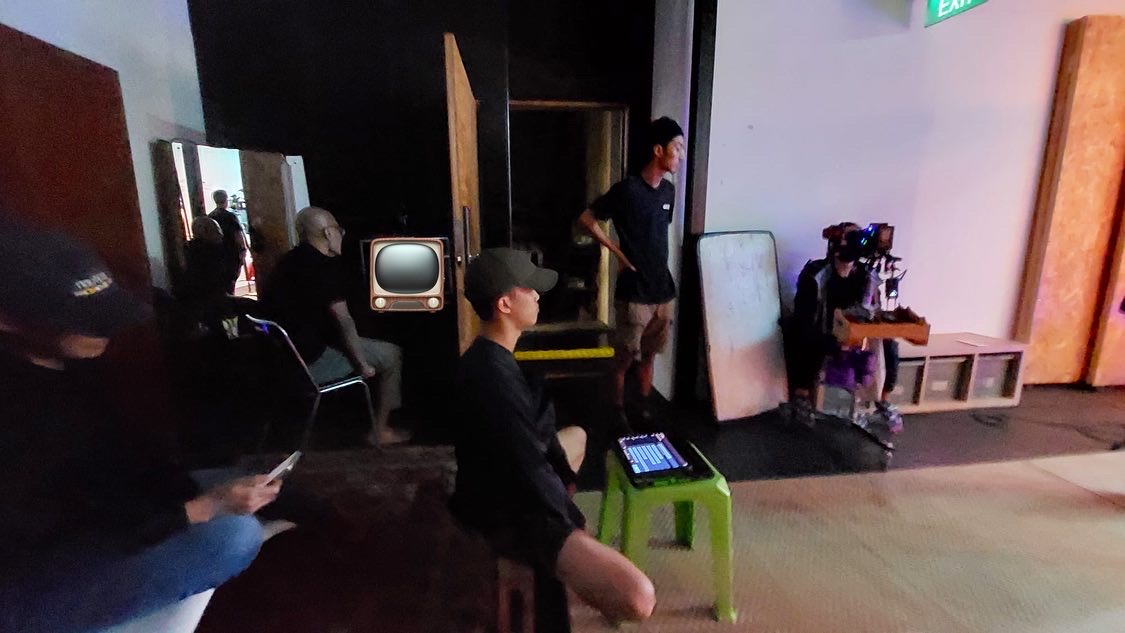
This is something I have been wanting to address for a long time, perhaps an unpopular opinion but that’s ok. (Creatives love to engage and talk cock.) Many of us, me included, gets excited when we’re on set - we get carried away and eager to show the world what we do and the fruits of our artistic endeavours.

It’s natural. Artists tend to be narcissists.

I think it’s ok to keep the end product mysterious (especially the ACTUAL shot onscreen). Not showing the process doesn’t devalue our worth as creative human beings.

We seem to be normalizing these reveals too damn early. I admit I have also been guilty of it sometimes.

Is it healthy to reveal the set, the costume, character styling way too early in production? Would we be devaluing the artistic process in the long run? There are multiple teams of people and departments working behind that Shot.

Perhaps it’s ok to reveal screenshots, costumes and sets only AFTER the project is exhibited. Or something within a curated marketing process closer to the exhibition date for maximum hit.

Between a tease and a reveal, I’ll choose the former. It’s fine with selfies and playful wefies as long as it doesn’t take away the artistry. It takes EVERYONE on set to work together to ensure the mystery of The Shot is maintained.

Some of my collaborators may have noticed this embargo being a contractual obligation previously. This is something I want to do better at - something I have enforced, especially on reeljuice sets.